Entrepreneur, Jan, 1996 by Robert McGarvey
When he was 25, Jim Rohn had pennies in his pocket, no money in the bank and creditors calling. He was straight off an Idaho farm, clerking in a store, and didn't have much planned for the future. Then Rohn met Earl Shoaffuan Entrepreneur who had made a fortune in vitaminsuand Shoaff told him his future would look exactly like his recent past . . . unless he made some big changes.
Like what? For starters, Shoaff told him he had to face the fact that it wasn't the government or taxes or competition that was keeping him down. What was? Rohn's own thinking about success: "My philosophy was all wrong," says Rohn. "I was preventing myself from succeeding."
So Rohn set about discarding his old thinking and adopting new disciplines for sharpening his skills and goals. "Do that," said Shoaff, "and you'll make millions."
Guess what? Shoaff was right. By age 31, Rohn had left clerking to become a top-flight salesman for Shoaffuand he had earned his first million. Rohn was on his way.
That was more than three decades ago, and today, Rohn is a staple on the motivational speaking circuit. But in an era where positive- thinking proponents are a dime a dozen, Rohn swims against the current by teaching the tough-love formula he learned from Shoaff. "It worked for me," he says, "and that formula for success works today just as it did yesterday."
Here, Rohnucreator of the videotape How to Have Your Best Year Everuoffers no easy answers, no quick rides to prosperity. But give him a close read, and you just may learn the secrets to the successes you dream of at night.
Entrepreneur: You say we have the ability to design our future. What about outside forces we can't controlusuch as competition, government regulations and so forth?
Jim Rohn: We tend to blame whatever happens to us on those external things, but we need to take personal responsibility. I used to say, "I sure hope things will change." Then I learned from my mentor, Earl Shoaff, that the only way things would change for me is when I changed.
We cannot change the circumstances, but we can change what we do. Either you design your future or somebody else will design it for youuand guess what they may have done for you? Not much. The ability to design our future is in our hands, if we wish it to be.
Entrepreneur: What's the key factor in determining our future?
Rohn: It's your philosophy, the sum total of what you knowuthat's your guidance system. Unless we are exposed to ideas that let us expand and refine our guidance system, we will get stuck with the system that was handed to us. If we learn from our experiences, other people's experiences, books and seminars, we can expand our guidance system. That helps us discard errors we had been making in the past and take on new disciplines for the future.
When I met my mentor at age 25, I had been working six years, but I was broke. Within the next six years, I was rich. What made the difference? Simply this: Correcting my old errors and setting up new disciplines. Mr. Shoaff told me to read, and I didunot trash but books full of information that I needed to know about sales, management, financial planning and more. He told me to take classes, and I did. And that's how I changed my philosophy.
But how can you think about changing unless someone presents you with alternative thinking? You won't change where you are overnight, but overnight you can change the direction in which you are going.
Entrepreneur: You have said that we can change our lives in a day, and in fact, you provide the prescription for doing so. What's the starting point?
Rohn: Disgust. Disgust is a negative emotion, but it can have a powerful impact on that day you become disgusted with being on your knees looking for pennies. It's the day when something clicks for youuand it can click for any of us.
One day years ago, a Girl Scout came to my door and asked if I would buy some cookies. I didn't have the money, so I lied to her and said, "I already bought lots of boxes." After she walked away, I said to myself, "I don't want to live like this. How low can I getulying to a Girl Scout?" That was a turning point for me.
Entrepreneur: Nowadays many of us have that kind of experience, and afterward we decide to "affirm" ourselves into prosperity by saying things like "I am living a wealthy, successful life." Does that work?
Rohn: Affirmations without disciplines are the beginning of delusion. I believe in affirmations if they are true. If you are broke, the best thing to affirm is "I am broke." Put that up on the refrigerator and see it every day until it becomes powerful enough to prompt you into a life change.
Until you see the truth about your condition, positive thinking won't work. Listening to thousands of pre-conscious, subconscious, high-tech affirmations will not help. All you have to say is "I am not where I want to be in life, and something is wrong. What? Something is wrong with my philosophy." Once you understand that, your life can totally change.
Entrepreneur: To start a life change, don't we first need to absorb a healthy dose of motivation?
Rohn: For 25 years, I have debated with motivational speakers who say we should start [changing a person's life] by building motivation. But I say if you are on the wrong track and you get motivated, you'll just get to disaster quicker.
The first step is for you to be unhappy about where you are and to accept the blame. This is a traumatic decision to come to, but once you recognize you need to do the new disciplines to make changes in your life, you can get motivated. But just walking around telling yourself "I'm terrific, and I'm getting better"uthat's not going to help.
Entrepreneur: What do you mean by "do the new disciplines"?
Rohn: Doing a discipline is trying things that lead to progress, to productivity. For example, a discipline might be taking a class one night a week to develop a new skill. Or reading a book a week, listening to tapes, making cold calls, creating a financial plan. All these are disciplines.
Discipline means we don't let go of the things we know we should be doinguwe do them! Disciplines are the miracle workers. Knowledge not invested in disciplines is wasted.
Entrepreneur: Where do we learn our disciplines?
Rohn: Most of us pick up our disciplines from the people who surround us. I teach people to ask themselves: "Who am I around? What are they doing to me? Is it OK?" To start the process of change, we may need to disassociate from some of the people we know, and we also need to expand our associations by finding people of value and spending more time with them. You want to be around people who have turned pennies into fortunes.
Entrepreneur: Should we avoid people who have failed?
Rohn: Not entirely. There are some people with whom you want limited contact. In fact, I teach that for proper learning, you should talk to the failures as well as the successes. It's too bad failures don't give seminars. It would be great to hear from someone who really messed up a business.
Entrepreneur: Isn't one of your key teachings that failure befalls us not as a result of a major catastrophe but because of a series of little neglects?
Rohn: That's all failure is. Neglect starts as an infection; if we don't take care of it, it becomes a disease. Here's the formula for failure: Failure is a few errors in judgment repeated every day. Success, on the other hand, is simply the natural consequence of consistently applying basic fundamentals.
Entrepreneur: Let's go back to that life-changing day. After we feel disgust, what do we need next?
Rohn: The desire to change. You have to want it bad enough to do it. A great mystery is why some have the desire and others don't. I've also known people in whom the desire was suppressed for years, and one day, suddenly, it's there.
Once you have the desire, get working. That's the next steputaking action. Since I was 25 years old, nobody has had to say to me "When are you going to get going?" Once you have the desire, you see rest as a necessity, not an objective. When you see rest as an objective, you haven't learned that the great delight in life isn't rest, it's productivityuand productivity only happens when you have the disciplines
Entrepreneur: On that life-changing day, what else do we need?
Rohn: Resolve. That means saying "I will do it in spite of (whatever) until I succeed. I will keep doing the disciplines."
Recognize, too, that your battle often is within yourself. It's the whispers in your mind that tell you to relax, to let that task go without doingujust for today. Resolve is the turning point where you just say, "I will do it."
Entrepreneur: How do we maintain resolve in the face of obstacles?
Rohn: Paying the price is easy when the promise is clear and powerful. True happiness is making steady progress toward defined goals. You won't get there all at once. But if you are making reasonable progress, that's the recipe for happiness. And as you make progress, your resolve grows.
Entrepreneur: What's the secret to goal-setting?
Rohn: I teach a simple process: Decide what you want, write it down, and regularly check off the steps you're taking toward your goal. That's simple, but success is usually the result of doing simple stuff.
Ask yourself, "What do I want? What skills do I have to develop to get there? How will I do it? What disciplines do I need to follow?"
Entrepreneur: You also teach that we should make it a discipline to regularly reflect on what's happened to us.
Rohn: Reviewing your experiences makes them more valuable for the future. I call it "running the tapes again." You see the highs and the lows, what you've done, and what you need to do.
At the end of every day, take a few minutes. At the end of every week, take a few hours. At the end of every month, take half a day. At the end of every year, take a weekend. We all need some solitude to think about who we're seeing, what we're doing, what went right, what went wrong. Reflection helps to lock the experiences in your mind so you can draw on them in the future.
Entrepreneur: What do you tell Entrepreneurs who say they understand what you are talking about but they're too busy?
Rohn: You cannot be too busy to reflect. This is the time when you will come up with new ideas and refinements of existing ideas that will let you double or triple your productivity. If you don't take that kind of time, it's easy to stay on the track you're on and to miss some really big stuff.
Entrepreneur: Why do you advise Entrepreneurs to work even harder on personal development than on business?
Rohn: Income seldom exceeds personal development. There may be a time where you have a little good fortune and your income soars beyond your level of development, but in time it will come back down. That's why you need the discipline to read that book, to take that class.
An Entrepreneur, in particular, needs to learn a variety of skills. Just a tiny refinement of your thinking can multiply your results. If you don't do ituif you don't studyuyou may be missing huge chunks of money and satisfaction.
Entrepreneur: When we're making progress on the road to success, what pitfalls should we look out for?
Rohn: The twin killers of success are greed and impatience. The movie "Wall Street" told us greed is good, but it isn't. Greed means working toward something at the expense of others. True ambition, which is good, means working toward something by serving others. Help enough people get what they want, and you will get whatever you want.
As for impatience, that's being unwilling to wait for the process to unfold. If you've only been at the disciplines for a week and you give them up because you are impatient, you've aced yourself out of what could have been your fortune.
Picture the farmer who plants his seeds and, a few days later, is out in the field saying "Where's my crop?" Of course the farmer is a fool, but how many of us forget that it takes time to build a great company? That's something every Entrepreneur needs to understand.
Entrepreneur: When you say "This stuff is easy," do you mean it's easy to understand?
Rohn: And to do. The key is to not neglect what's easy. Is reading a book hard? Taking a class? Ask a person why he or she neglects the easy stuff, and you'll never hear a good answer. If there's something we should do and we don't do it, whose fault is that? Nobody's but our own.
Anybody, anywhere can take the steps toward success. Success isn't magical or mysterious. It's easy if we consistently follow the disciplines. As time unfolds, add more disciplines. As you accomplish one goal, go for the next. Just have patience with yourself, and in due time, you will do it.
COPYRIGHT 1996 Entrepreneur Media, Inc.
COPYRIGHT 2004 Gale Group

wireless yogi
Just do it - motivational speaker Jim Rohn - Interview
Entrepreneur, Jan, 1996 by Robert McGarvey
12345Next
When he was 25, Jim Rohn had pennies in his pocket, no money in the bank and creditors calling. He was straight off an Idaho farm, clerking in a store, and didn't have much planned for the future. Then Rohn met Earl Shoaffuan Entrepreneur who had made a fortune in vitaminsuand Shoaff told him his future would look exactly like his recent past . . . unless he made some big changes.
Like what? For starters, Shoaff told him he had to face the fact that it wasn't the government or taxes or competition that was keeping him down. What was? Rohn's own thinking about success: "My philosophy was all wrong," says Rohn. "I was preventing myself from succeeding."
So Rohn set about discarding his old thinking and adopting new disciplines for sharpening his skills and goals. "Do that," said Shoaff, "and you'll make millions."
Guess what? Shoaff was right. By age 31, Rohn had left clerking to become a top-flight salesman for Shoaffuand he had earned his first million. Rohn was on his way.
That was more than three decades ago, and today, Rohn is a staple on the motivational speaking circuit. But in an era where positive- thinking proponents are a dime a dozen, Rohn swims against the current by teaching the tough-love formula he learned from Shoaff. "It worked for me," he says, "and that formula for success works today just as it did yesterday."
Here, Rohnucreator of the videotape How to Have Your Best Year Everuoffers no easy answers, no quick rides to prosperity. But give him a close read, and you just may learn the secrets to the successes you dream of at night.
Entrepreneur: You say we have the ability to design our future. What about outside forces we can't controlusuch as competition, government regulations and so forth?
Jim Rohn: We tend to blame whatever happens to us on those external things, but we need to take personal responsibility. I used to say, "I sure hope things will change." Then I learned from my mentor, Earl Shoaff, that the only way things would change for me is when I changed.
We cannot change the circumstances, but we can change what we do. Either you design your future or somebody else will design it for youuand guess what they may have done for you? Not much. The ability to design our future is in our hands, if we wish it to be.
Entrepreneur: What's the key factor in determining our future?
Rohn: It's your philosophy, the sum total of what you knowuthat's your guidance system. Unless we are exposed to ideas that let us expand and refine our guidance system, we will get stuck with the system that was handed to us. If we learn from our experiences, other people's experiences, books and seminars, we can expand our guidance system. That helps us discard errors we had been making in the past and take on new disciplines for the future.
When I met my mentor at age 25, I had been working six years, but I was broke. Within the next six years, I was rich. What made the difference? Simply this: Correcting my old errors and setting up new disciplines. Mr. Shoaff told me to read, and I didunot trash but books full of information that I needed to know about sales, management, financial planning and more. He told me to take classes, and I did. And that's how I changed my philosophy.
But how can you think about changing unless someone presents you with alternative thinking? You won't change where you are overnight, but overnight you can change the direction in which you are going.
Entrepreneur: You have said that we can change our lives in a day, and in fact, you provide the prescription for doing so. What's the starting point?
Rohn: Disgust. Disgust is a negative emotion, but it can have a powerful impact on that day you become disgusted with being on your knees looking for pennies. It's the day when something clicks for youuand it can click for any of us.
One day years ago, a Girl Scout came to my door and asked if I would buy some cookies. I didn't have the money, so I lied to her and said, "I already bought lots of boxes." After she walked away, I said to myself, "I don't want to live like this. How low can I getulying to a Girl Scout?" That was a turning point for me.
Entrepreneur: Nowadays many of us have that kind of experience, and afterward we decide to "affirm" ourselves into prosperity by saying things like "I am living a wealthy, successful life." Does that work?
Rohn: Affirmations without disciplines are the beginning of delusion. I believe in affirmations if they are true. If you are broke, the best thing to affirm is "I am broke." Put that up on the refrigerator and see it every day until it becomes powerful enough to prompt you into a life change.
Until you see the truth about your condition, positive thinking won't work. Listening to thousands of pre-conscious, subconscious, high-tech affirmations will not help. All you have to say is "I am not where I want to be in life, and something is wrong. What? Something is wrong with my philosophy." Once you understand that, your life can totally change.
Entrepreneur: To start a life change, don't we first need to absorb a healthy dose of motivation?
Rohn: For 25 years, I have debated with motivational speakers who say we should start [changing a person's life] by building motivation. But I say if you are on the wrong track and you get motivated, you'll just get to disaster quicker.
The first step is for you to be unhappy about where you are and to accept the blame. This is a traumatic decision to come to, but once you recognize you need to do the new disciplines to make changes in your life, you can get motivated. But just walking around telling yourself "I'm terrific, and I'm getting better"uthat's not going to help.
Entrepreneur: What do you mean by "do the new disciplines"?
Rohn: Doing a discipline is trying things that lead to progress, to productivity. For example, a discipline might be taking a class one night a week to develop a new skill. Or reading a book a week, listening to tapes, making cold calls, creating a financial plan. All these are disciplines.
Discipline means we don't let go of the things we know we should be doinguwe do them! Disciplines are the miracle workers. Knowledge not invested in disciplines is wasted.
Entrepreneur: Where do we learn our disciplines?
Rohn: Most of us pick up our disciplines from the people who surround us. I teach people to ask themselves: "Who am I around? What are they doing to me? Is it OK?" To start the process of change, we may need to disassociate from some of the people we know, and we also need to expand our associations by finding people of value and spending more time with them. You want to be around people who have turned pennies into fortunes.
Entrepreneur: Should we avoid people who have failed?
Rohn: Not entirely. There are some people with whom you want limited contact. In fact, I teach that for proper learning, you should talk to the failures as well as the successes. It's too bad failures don't give seminars. It would be great to hear from someone who really messed up a business.
Entrepreneur: Isn't one of your key teachings that failure befalls us not as a result of a major catastrophe but because of a series of little neglects?
Rohn: That's all failure is. Neglect starts as an infection; if we don't take care of it, it becomes a disease. Here's the formula for failure: Failure is a few errors in judgment repeated every day. Success, on the other hand, is simply the natural consequence of consistently applying basic fundamentals.
Entrepreneur: Let's go back to that life-changing day. After we feel disgust, what do we need next?
Rohn: The desire to change. You have to want it bad enough to do it. A great mystery is why some have the desire and others don't. I've also known people in whom the desire was suppressed for years, and one day, suddenly, it's there.
Once you have the desire, get working. That's the next steputaking action. Since I was 25 years old, nobody has had to say to me "When are you going to get going?" Once you have the desire, you see rest as a necessity, not an objective. When you see rest as an objective, you haven't learned that the great delight in life isn't rest, it's productivityuand productivity only happens when you have the disciplines
Entrepreneur: On that life-changing day, what else do we need?
Rohn: Resolve. That means saying "I will do it in spite of (whatever) until I succeed. I will keep doing the disciplines."
Recognize, too, that your battle often is within yourself. It's the whispers in your mind that tell you to relax, to let that task go without doingujust for today. Resolve is the turning point where you just say, "I will do it."
Entrepreneur: How do we maintain resolve in the face of obstacles?
Rohn: Paying the price is easy when the promise is clear and powerful. True happiness is making steady progress toward defined goals. You won't get there all at once. But if you are making reasonable progress, that's the recipe for happiness. And as you make progress, your resolve grows.
Entrepreneur: What's the secret to goal-setting?
Rohn: I teach a simple process: Decide what you want, write it down, and regularly check off the steps you're taking toward your goal. That's simple, but success is usually the result of doing simple stuff.
Ask yourself, "What do I want? What skills do I have to develop to get there? How will I do it? What disciplines do I need to follow?"
Entrepreneur: You also teach that we should make it a discipline to regularly reflect on what's happened to us.
Rohn: Reviewing your experiences makes them more valuable for the future. I call it "running the tapes again." You see the highs and the lows, what you've done, and what you need to do.
At the end of every day, take a few minutes. At the end of every week, take a few hours. At the end of every month, take half a day. At the end of every year, take a weekend. We all need some solitude to think about who we're seeing, what we're doing, what went right, what went wrong. Reflection helps to lock the experiences in your mind so you can draw on them in the future.
Entrepreneur: What do you tell Entrepreneurs who say they understand what you are talking about but they're too busy?
Rohn: You cannot be too busy to reflect. This is the time when you will come up with new ideas and refinements of existing ideas that will let you double or triple your productivity. If you don't take that kind of time, it's easy to stay on the track you're on and to miss some really big stuff.
Entrepreneur: Why do you advise Entrepreneurs to work even harder on personal development than on business?
Rohn: Income seldom exceeds personal development. There may be a time where you have a little good fortune and your income soars beyond your level of development, but in time it will come back down. That's why you need the discipline to read that book, to take that class.
An Entrepreneur, in particular, needs to learn a variety of skills. Just a tiny refinement of your thinking can multiply your results. If you don't do ituif you don't studyuyou may be missing huge chunks of money and satisfaction.
Entrepreneur: When we're making progress on the road to success, what pitfalls should we look out for?
Rohn: The twin killers of success are greed and impatience. The movie "Wall Street" told us greed is good, but it isn't. Greed means working toward something at the expense of others. True ambition, which is good, means working toward something by serving others. Help enough people get what they want, and you will get whatever you want.
As for impatience, that's being unwilling to wait for the process to unfold. If you've only been at the disciplines for a week and you give them up because you are impatient, you've aced yourself out of what could have been your fortune.
Picture the farmer who plants his seeds and, a few days later, is out in the field saying "Where's my crop?" Of course the farmer is a fool, but how many of us forget that it takes time to build a great company? That's something every Entrepreneur needs to understand.
Entrepreneur: When you say "This stuff is easy," do you mean it's easy to understand?
Rohn: And to do. The key is to not neglect what's easy. Is reading a book hard? Taking a class? Ask a person why he or she neglects the easy stuff, and you'll never hear a good answer. If there's something we should do and we don't do it, whose fault is that? Nobody's but our own.
Anybody, anywhere can take the steps toward success. Success isn't magical or mysterious. It's easy if we consistently follow the disciplines. As time unfolds, add more disciplines. As you accomplish one goal, go for the next. Just have patience with yourself, and in due time, you will do it.
COPYRIGHT 1996 Entrepreneur Media, Inc.
COPYRIGHT 2004 Gale Group
12345Next
When he was 25, Jim Rohn had pennies in his pocket, no money in the bank and creditors calling. He was straight off an Idaho farm, clerking in a store, and didn't have much planned for the future. Then Rohn met Earl Shoaffuan Entrepreneur who had made a fortune in vitaminsuand Shoaff told him his future would look exactly like his recent past . . . unless he made some big changes.
Like what? For starters, Shoaff told him he had to face the fact that it wasn't the government or taxes or competition that was keeping him down. What was? Rohn's own thinking about success: "My philosophy was all wrong," says Rohn. "I was preventing myself from succeeding."
So Rohn set about discarding his old thinking and adopting new disciplines for sharpening his skills and goals. "Do that," said Shoaff, "and you'll make millions."
Guess what? Shoaff was right. By age 31, Rohn had left clerking to become a top-flight salesman for Shoaffuand he had earned his first million. Rohn was on his way.
That was more than three decades ago, and today, Rohn is a staple on the motivational speaking circuit. But in an era where positive- thinking proponents are a dime a dozen, Rohn swims against the current by teaching the tough-love formula he learned from Shoaff. "It worked for me," he says, "and that formula for success works today just as it did yesterday."
Here, Rohnucreator of the videotape How to Have Your Best Year Everuoffers no easy answers, no quick rides to prosperity. But give him a close read, and you just may learn the secrets to the successes you dream of at night.
Entrepreneur: You say we have the ability to design our future. What about outside forces we can't controlusuch as competition, government regulations and so forth?
Jim Rohn: We tend to blame whatever happens to us on those external things, but we need to take personal responsibility. I used to say, "I sure hope things will change." Then I learned from my mentor, Earl Shoaff, that the only way things would change for me is when I changed.
We cannot change the circumstances, but we can change what we do. Either you design your future or somebody else will design it for youuand guess what they may have done for you? Not much. The ability to design our future is in our hands, if we wish it to be.
Entrepreneur: What's the key factor in determining our future?
Rohn: It's your philosophy, the sum total of what you knowuthat's your guidance system. Unless we are exposed to ideas that let us expand and refine our guidance system, we will get stuck with the system that was handed to us. If we learn from our experiences, other people's experiences, books and seminars, we can expand our guidance system. That helps us discard errors we had been making in the past and take on new disciplines for the future.
When I met my mentor at age 25, I had been working six years, but I was broke. Within the next six years, I was rich. What made the difference? Simply this: Correcting my old errors and setting up new disciplines. Mr. Shoaff told me to read, and I didunot trash but books full of information that I needed to know about sales, management, financial planning and more. He told me to take classes, and I did. And that's how I changed my philosophy.
But how can you think about changing unless someone presents you with alternative thinking? You won't change where you are overnight, but overnight you can change the direction in which you are going.
Entrepreneur: You have said that we can change our lives in a day, and in fact, you provide the prescription for doing so. What's the starting point?
Rohn: Disgust. Disgust is a negative emotion, but it can have a powerful impact on that day you become disgusted with being on your knees looking for pennies. It's the day when something clicks for youuand it can click for any of us.
One day years ago, a Girl Scout came to my door and asked if I would buy some cookies. I didn't have the money, so I lied to her and said, "I already bought lots of boxes." After she walked away, I said to myself, "I don't want to live like this. How low can I getulying to a Girl Scout?" That was a turning point for me.
Entrepreneur: Nowadays many of us have that kind of experience, and afterward we decide to "affirm" ourselves into prosperity by saying things like "I am living a wealthy, successful life." Does that work?
Rohn: Affirmations without disciplines are the beginning of delusion. I believe in affirmations if they are true. If you are broke, the best thing to affirm is "I am broke." Put that up on the refrigerator and see it every day until it becomes powerful enough to prompt you into a life change.
Until you see the truth about your condition, positive thinking won't work. Listening to thousands of pre-conscious, subconscious, high-tech affirmations will not help. All you have to say is "I am not where I want to be in life, and something is wrong. What? Something is wrong with my philosophy." Once you understand that, your life can totally change.
Entrepreneur: To start a life change, don't we first need to absorb a healthy dose of motivation?
Rohn: For 25 years, I have debated with motivational speakers who say we should start [changing a person's life] by building motivation. But I say if you are on the wrong track and you get motivated, you'll just get to disaster quicker.
The first step is for you to be unhappy about where you are and to accept the blame. This is a traumatic decision to come to, but once you recognize you need to do the new disciplines to make changes in your life, you can get motivated. But just walking around telling yourself "I'm terrific, and I'm getting better"uthat's not going to help.
Entrepreneur: What do you mean by "do the new disciplines"?
Rohn: Doing a discipline is trying things that lead to progress, to productivity. For example, a discipline might be taking a class one night a week to develop a new skill. Or reading a book a week, listening to tapes, making cold calls, creating a financial plan. All these are disciplines.
Discipline means we don't let go of the things we know we should be doinguwe do them! Disciplines are the miracle workers. Knowledge not invested in disciplines is wasted.
Entrepreneur: Where do we learn our disciplines?
Rohn: Most of us pick up our disciplines from the people who surround us. I teach people to ask themselves: "Who am I around? What are they doing to me? Is it OK?" To start the process of change, we may need to disassociate from some of the people we know, and we also need to expand our associations by finding people of value and spending more time with them. You want to be around people who have turned pennies into fortunes.
Entrepreneur: Should we avoid people who have failed?
Rohn: Not entirely. There are some people with whom you want limited contact. In fact, I teach that for proper learning, you should talk to the failures as well as the successes. It's too bad failures don't give seminars. It would be great to hear from someone who really messed up a business.
Entrepreneur: Isn't one of your key teachings that failure befalls us not as a result of a major catastrophe but because of a series of little neglects?
Rohn: That's all failure is. Neglect starts as an infection; if we don't take care of it, it becomes a disease. Here's the formula for failure: Failure is a few errors in judgment repeated every day. Success, on the other hand, is simply the natural consequence of consistently applying basic fundamentals.
Entrepreneur: Let's go back to that life-changing day. After we feel disgust, what do we need next?
Rohn: The desire to change. You have to want it bad enough to do it. A great mystery is why some have the desire and others don't. I've also known people in whom the desire was suppressed for years, and one day, suddenly, it's there.
Once you have the desire, get working. That's the next steputaking action. Since I was 25 years old, nobody has had to say to me "When are you going to get going?" Once you have the desire, you see rest as a necessity, not an objective. When you see rest as an objective, you haven't learned that the great delight in life isn't rest, it's productivityuand productivity only happens when you have the disciplines
Entrepreneur: On that life-changing day, what else do we need?
Rohn: Resolve. That means saying "I will do it in spite of (whatever) until I succeed. I will keep doing the disciplines."
Recognize, too, that your battle often is within yourself. It's the whispers in your mind that tell you to relax, to let that task go without doingujust for today. Resolve is the turning point where you just say, "I will do it."
Entrepreneur: How do we maintain resolve in the face of obstacles?
Rohn: Paying the price is easy when the promise is clear and powerful. True happiness is making steady progress toward defined goals. You won't get there all at once. But if you are making reasonable progress, that's the recipe for happiness. And as you make progress, your resolve grows.
Entrepreneur: What's the secret to goal-setting?
Rohn: I teach a simple process: Decide what you want, write it down, and regularly check off the steps you're taking toward your goal. That's simple, but success is usually the result of doing simple stuff.
Ask yourself, "What do I want? What skills do I have to develop to get there? How will I do it? What disciplines do I need to follow?"
Entrepreneur: You also teach that we should make it a discipline to regularly reflect on what's happened to us.
Rohn: Reviewing your experiences makes them more valuable for the future. I call it "running the tapes again." You see the highs and the lows, what you've done, and what you need to do.
At the end of every day, take a few minutes. At the end of every week, take a few hours. At the end of every month, take half a day. At the end of every year, take a weekend. We all need some solitude to think about who we're seeing, what we're doing, what went right, what went wrong. Reflection helps to lock the experiences in your mind so you can draw on them in the future.
Entrepreneur: What do you tell Entrepreneurs who say they understand what you are talking about but they're too busy?
Rohn: You cannot be too busy to reflect. This is the time when you will come up with new ideas and refinements of existing ideas that will let you double or triple your productivity. If you don't take that kind of time, it's easy to stay on the track you're on and to miss some really big stuff.
Entrepreneur: Why do you advise Entrepreneurs to work even harder on personal development than on business?
Rohn: Income seldom exceeds personal development. There may be a time where you have a little good fortune and your income soars beyond your level of development, but in time it will come back down. That's why you need the discipline to read that book, to take that class.
An Entrepreneur, in particular, needs to learn a variety of skills. Just a tiny refinement of your thinking can multiply your results. If you don't do ituif you don't studyuyou may be missing huge chunks of money and satisfaction.
Entrepreneur: When we're making progress on the road to success, what pitfalls should we look out for?
Rohn: The twin killers of success are greed and impatience. The movie "Wall Street" told us greed is good, but it isn't. Greed means working toward something at the expense of others. True ambition, which is good, means working toward something by serving others. Help enough people get what they want, and you will get whatever you want.
As for impatience, that's being unwilling to wait for the process to unfold. If you've only been at the disciplines for a week and you give them up because you are impatient, you've aced yourself out of what could have been your fortune.
Picture the farmer who plants his seeds and, a few days later, is out in the field saying "Where's my crop?" Of course the farmer is a fool, but how many of us forget that it takes time to build a great company? That's something every Entrepreneur needs to understand.
Entrepreneur: When you say "This stuff is easy," do you mean it's easy to understand?
Rohn: And to do. The key is to not neglect what's easy. Is reading a book hard? Taking a class? Ask a person why he or she neglects the easy stuff, and you'll never hear a good answer. If there's something we should do and we don't do it, whose fault is that? Nobody's but our own.
Anybody, anywhere can take the steps toward success. Success isn't magical or mysterious. It's easy if we consistently follow the disciplines. As time unfolds, add more disciplines. As you accomplish one goal, go for the next. Just have patience with yourself, and in due time, you will do it.
COPYRIGHT 1996 Entrepreneur Media, Inc.
COPYRIGHT 2004 Gale Group
Formula 1 boss Christian Horner: 'Don't let them tell you you're too young

The new Formula 1 champion Sebastian Vettel may be a German, but it's a Brit who's largely responsible for his success. Christian Horner, 37, has been team principal of Red Bull Racing since 2004, when Austrian billionaire Dietrich Mateschitz bought the former Jaguar F1 team. Born in Leamington Spa, Horner started out as a driver, having raced karts from the age of 11.
After competing in Formula Renault, Formula 3 and Formula 2, he founded his own team, Arden, for his move to Formula 3000 in 1997, before switching to management.
'It was never an issue to me to be the youngest boss in the business, and while there were some doubters who thought, 'Who's this upstart?', I was able to build a strong group around me,' said Christian Horner
Set your goals as early as you can.
I was fascinated by speed as a child, and I did a deal with my parents to take a year out to see if I could make my way in motorsport. It proved to be a very rapid education. I was having to deal with all kinds of people and learn on the job. My friends at university were doing eight hours a week; I was doing eight hours a day. It was the classic university of life, and I wouldn't change it for anything.
Don't let them tell you you're too young.
Age is no barrier. It should be down to who you are and how you conduct yourself. It was never an issue to me to be the youngest boss in the business, and while there were some doubters who thought, 'Who's this upstart?', I was able to build a strong group around me.
Understand the mechanics of organisations.
Dave Richards (former F1 boss and Aston Martin chairman) was hugely supportive in helping me develop Arden. He became a partner for a while and gave me plenty of useful advice. I moved my team up to the site of his company, Prodrive, in Banbury, Oxfordshire, and it gave me a great insight into how a big organisation functions. Getting inside those places and seeing how they operate is crucial.
Give 100 per cent.
If you have a talent, focus all your time and attention on it. Only a handful of drivers get to the top in F1, but who says it won't be you? Both Sebastian Vettel and Mark Webber came from humble backgrounds, but through talent and determination they've succeeded. Cream always rises to the top.
Be honest with yourself.
In 1998 I was competing against top drivers like Juan Pablo Montoya and Nick Heidfeld and I had to admit I wasn't at their level. I didn't have the talent, so rather than keep chasing a dream that wasn't going to happen, I decided to focus my attention elsewhere.
Build from the bottom up.
Arden was a start-up - two mechanics, one part-time in an off -licence, an engineer and a part-time truck driver. From there we were able to create the most successful team in F3000 of that era.
Take risks.
I had a good sponsorship package from a Russian oil company, but I bought back the shares, took full control of the business and went for it by employing two top drivers. Financially it was disastrous. I was hustling deals just to keep the cars on the track and pay the engineers, but I had nothing to lose. It was stressful, but I had few overheads and no family commitments. I put every penny I had into that year and it paid o ff.
Get everyone rowing together.
You can have the best, but they have to be in tune as a team. Jaguar had a talented team, but when we took them over in 2004 they'd never managed to achieve much success. We still have many of
those people here. It was a matter of getting them to pull in the right direction.
Go for the top talent.
My strategy in F3000 was to go and find the best mechanics, the best technicians and the best drivers. I took that into Red Bull, particularly when it came to employing Adrian Newey to design the car, because he's the best guy in the business.
Encourage team spirit.
The commitment and sacrifices made within Red Bull this season have been phenomenal. We had receptionists volunteering to jump on a plane with a component to make sure we could put a competitive car on the track. In Istanbul a rear wing arrived minutes before the qualifying session, allowing Mark Webber to take pole. There are a lot of unsung heroes here. The driver is just the frontman.
Don't look for scapegoats.
Stability and continuity are key factors in success. Jaguar had a revolving door of management, and that's not our way. We win as a team and lose as a team. Once you're in a blame culture you're on a slippery slope.
Think outside the box.
If you're not a Ferrari or a McLaren you have to rely on creative solutions. The car is e ffectively a prototype at each race, and it's relentless. Measures have been introduced in F1 to restrict spending, which is good. We've been prudent and successful. The gap has narrowed, because we have thought creatively and innovatively to ensure every penny spent is justified.
Back your instincts.
Race strategy is vital and we've developed complex software that runs through thousands of permutations dependent on the scenario, but sometimes you have to go with your gut instinct. In Singapore we pitted Mark early under the safety car when logically it wasn't the right thing to do. It was a gamble, but the upside was he finished on the podium rather than sixth.
Don't play favourites.
It was important that Mark and Sebastian could see they were getting the same support and equipment. When you have two guys competing for the biggest goal in motorsport, tension is inevitable, but they brought the best out of each other. We didn't favour either one, and if we had we'd have lost the championship. Mark and Sebastian had a long discussion after the season ended, and they're fine. We've seen how teams can be split by issues between drivers, but I'm confident that won't be the case next season.
Read more: http://www.dailymail.co.uk/home/moslive/article-1337519/Formula-1-boss-Christian-Horner-Dont-let-tell-youre-young.html#ixzz180yvVoj4
DEC 10, 2010 11:39 EST
What started out as a small group of activists operating a clearing house for leaked secret documents, WikiLeaks looks like it is turning into an international grass roots movement that needs no central figure to fight a “data war” in the name of Internet freedom.
It could be a long war, no matter whether Julian Assange, the founder of WikiLeaks, remains the world’s most prominent anti-secrecy figure or not.
Since November 28, when WikiLeaks began releasing a quarter of a million classified U.S. State Department cables from embassies around the world, there have been several attempts to drive the organization off the Internet and cut its channels for receiving donations. A day after Assange was arrested in London, Internet activists struck back.
While he was in prison, cut off from contact with his organization, computer hackers attacked the websites of MasterCard, Visa, and PayPal which had stopped processing donations for WikiLeaks; Amazon.com, which had banished WikiLeaks from using its rented servers; a Swiss bank and the website of the Swedish prosecutor who had issued an arrest warrant for Assange on charges of sexual misconduct.
“This movement is bigger than Assange,” said a comment in one of the dozens of passionate Internet debates on Operation Payback, as the counter-attack was called. Peter LaVenia, a leader of the New York State Green Party, described WikiLeaks as “the most important thing to happen to the cause of democratic rule” since the student revolts of 1968 in the U.S. and Europe. The mood and tone of pro-WikiLeak activists indeed evoke memories of the anti-establishment sentiment of 1968.
Since 2007, when Assange, a 39-year-old ex-hacker, set up WikiLeaks, his organization has been closely identified with him as the indispensable leader. He has described himself as “the heart and soul of this organization, its founder, philosopher, spokesperson, original coder, organizer, financier and all the rest.” But the last few days of “hacktivism” show that even without him, the genie he uncorked could not be stuffed back into the bottle.
“This is cyber guerrilla warfare,” said Charles Dodd, a consultant to U.S. government agencies on cyber security. “They attack from the shadows and they have no fear of retaliation. There are no rules of engagement in this kind of emerging warfare.”
In the Kalashnikov-carrying kind of guerrilla war, one of the aims is to provoke the government into harsh reactions that generate sympathy for the cause and attract new followers. The American reaction to WikiLeaks’ dump of embassy cables seems to have achieved just that.
PRESSURE AND INTIMIDATION
Politicians from both sides of the spectrum have portrayed him as an arch-villain. Right-wing pundits have called for his assassination. Mike Huckabee, a presidential contender in 2008, says he should be executed.
The companies that cut off ties with WikiLeaks denied having caved to pressure from the U.S. government, but that was not the perception abroad.
In Geneva, the United Nations High Commissioner for Human Rights, Navi Pillay, expressed “concern about reports” of pressure on private companies to close down credit lines for WikiLeak donations. “If WikiLeaks has committed any recognizable illegal act, then this should be handled through the legal system,” she said, “and not through pressure and intimidation including on third parties.”
Particularly not, she might have added, in a country whose Secretary of State, Hillary Clinton, had waxed lyrical in a speech in January about an Internet free of government interference and the need for American companies not to buckle to any form of censorship. “American companies need to make a principled stand. This needs to be part of our national brand.”
Nice words, well delivered. But the before-and-after WikiLeaks comparison of Clinton statements is stark. The leaks of the cables, many with brutally frank assessments of foreign leaders, were not just an attack on America’s foreign policy interests but “an attack on the international community,” she said. Clinton did not return to the subject of principled American companies or the national brand.
President Barack Obama has stayed away from the WikiLeaks controversy entirely. But his attorney general, Eric Holder, is trying to put together a legal case that would allow Assange’s extradition from Sweden to the United States. It’s a hard case to make because officials have yet to answer convincingly the question why WikiLeaks’ boss should be tried and not executives of the New York Times, the U.S. newspaper that printed some of the most sensitive leaked correspondence.
Getting Assange, an Australian, into an American court would also be a serious tactical mistake. It would turn him into a free speech martyr at a time disaffected former WikiLeaks staffers are preparing to launch a rival anti-secrecy site. Why? They left because of his high-handed management style and the organization’s lack of transparency.
The respected Stockholm newspaper Dagens Nyheter quoted one of the prospective founders of the new group as saying they wanted an organization that was “democratically governed, rather than limited to one group or individual.” That doesn’t mean letting up on making official secrets public.
“Our long-term goal is to build a strong, transparent platform to support whistleblowers, while at the same time encouraging others to start similar projects.”
http://blogs.reuters.com/bernddebusmann/2010/12/10/wikileaks-cyberwar-and-julian-assange/
What started out as a small group of activists operating a clearing house for leaked secret documents, WikiLeaks looks like it is turning into an international grass roots movement that needs no central figure to fight a “data war” in the name of Internet freedom.
It could be a long war, no matter whether Julian Assange, the founder of WikiLeaks, remains the world’s most prominent anti-secrecy figure or not.
Since November 28, when WikiLeaks began releasing a quarter of a million classified U.S. State Department cables from embassies around the world, there have been several attempts to drive the organization off the Internet and cut its channels for receiving donations. A day after Assange was arrested in London, Internet activists struck back.
While he was in prison, cut off from contact with his organization, computer hackers attacked the websites of MasterCard, Visa, and PayPal which had stopped processing donations for WikiLeaks; Amazon.com, which had banished WikiLeaks from using its rented servers; a Swiss bank and the website of the Swedish prosecutor who had issued an arrest warrant for Assange on charges of sexual misconduct.
“This movement is bigger than Assange,” said a comment in one of the dozens of passionate Internet debates on Operation Payback, as the counter-attack was called. Peter LaVenia, a leader of the New York State Green Party, described WikiLeaks as “the most important thing to happen to the cause of democratic rule” since the student revolts of 1968 in the U.S. and Europe. The mood and tone of pro-WikiLeak activists indeed evoke memories of the anti-establishment sentiment of 1968.
Since 2007, when Assange, a 39-year-old ex-hacker, set up WikiLeaks, his organization has been closely identified with him as the indispensable leader. He has described himself as “the heart and soul of this organization, its founder, philosopher, spokesperson, original coder, organizer, financier and all the rest.” But the last few days of “hacktivism” show that even without him, the genie he uncorked could not be stuffed back into the bottle.
“This is cyber guerrilla warfare,” said Charles Dodd, a consultant to U.S. government agencies on cyber security. “They attack from the shadows and they have no fear of retaliation. There are no rules of engagement in this kind of emerging warfare.”
In the Kalashnikov-carrying kind of guerrilla war, one of the aims is to provoke the government into harsh reactions that generate sympathy for the cause and attract new followers. The American reaction to WikiLeaks’ dump of embassy cables seems to have achieved just that.
PRESSURE AND INTIMIDATION
Politicians from both sides of the spectrum have portrayed him as an arch-villain. Right-wing pundits have called for his assassination. Mike Huckabee, a presidential contender in 2008, says he should be executed.
The companies that cut off ties with WikiLeaks denied having caved to pressure from the U.S. government, but that was not the perception abroad.
In Geneva, the United Nations High Commissioner for Human Rights, Navi Pillay, expressed “concern about reports” of pressure on private companies to close down credit lines for WikiLeak donations. “If WikiLeaks has committed any recognizable illegal act, then this should be handled through the legal system,” she said, “and not through pressure and intimidation including on third parties.”
Particularly not, she might have added, in a country whose Secretary of State, Hillary Clinton, had waxed lyrical in a speech in January about an Internet free of government interference and the need for American companies not to buckle to any form of censorship. “American companies need to make a principled stand. This needs to be part of our national brand.”
Nice words, well delivered. But the before-and-after WikiLeaks comparison of Clinton statements is stark. The leaks of the cables, many with brutally frank assessments of foreign leaders, were not just an attack on America’s foreign policy interests but “an attack on the international community,” she said. Clinton did not return to the subject of principled American companies or the national brand.
President Barack Obama has stayed away from the WikiLeaks controversy entirely. But his attorney general, Eric Holder, is trying to put together a legal case that would allow Assange’s extradition from Sweden to the United States. It’s a hard case to make because officials have yet to answer convincingly the question why WikiLeaks’ boss should be tried and not executives of the New York Times, the U.S. newspaper that printed some of the most sensitive leaked correspondence.
Getting Assange, an Australian, into an American court would also be a serious tactical mistake. It would turn him into a free speech martyr at a time disaffected former WikiLeaks staffers are preparing to launch a rival anti-secrecy site. Why? They left because of his high-handed management style and the organization’s lack of transparency.
The respected Stockholm newspaper Dagens Nyheter quoted one of the prospective founders of the new group as saying they wanted an organization that was “democratically governed, rather than limited to one group or individual.” That doesn’t mean letting up on making official secrets public.
“Our long-term goal is to build a strong, transparent platform to support whistleblowers, while at the same time encouraging others to start similar projects.”
http://blogs.reuters.com/bernddebusmann/2010/12/10/wikileaks-cyberwar-and-julian-assange/
Snaptu: Talktatone Makes Free Google Voice/Gmail VoIP Calls on Your iPhone [VoIP]
iOS only: Gmail users can make free Google Voice calls, but why should they have all the fun? Talkatone sets up free VoIP calls, over 3G or Wi-Fi, from your iPhone, iPod, or iPad through Google Voice for free.
Talkatone does quite a few other neat...
Click here to read the full story
--This email was sent to you from Snaptu mobile application.
Is Wikileaks An Internet 9-11?

by Zen Gardner
Think about it. Where is this seemingly staged Wikileaks furor taking us? While we participate in digging into the juicy tidbits of information that incriminate just about anybody and everybody, where is it all going?
Lessons of 9/11
While 9/11 served as a wake up call to those awake and aware enough to see the obvious demolitions and misinformation and resultant "Pearl Harbor" effect, most of the world fell for it. And now people are literally bending over, as in airport 'screenings', to the onslaught of police state fascism worldwide. It's staggering. In fact, it's Orwellian. The armies, police and private sector are at war with the vague concept of terrorism – an unbeatable enemy in a war that can be drawn out indefinitely and fought in any arena necessary.
And what was the result of this declared war on terrorism? Not a war on terror, but an increase in fear and terror, all to justify the economic, social and political clampdown that has followed.
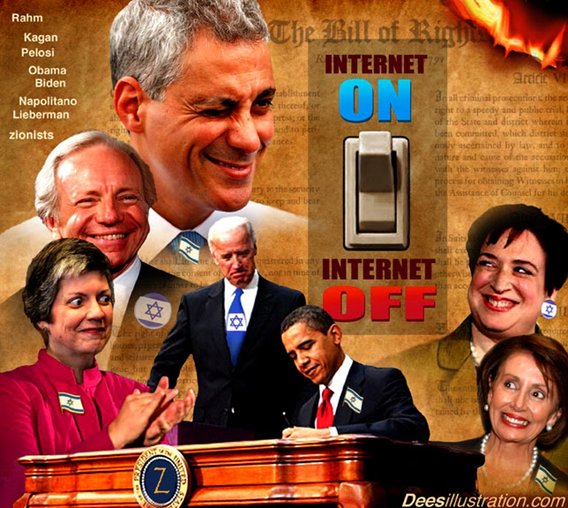
What will the Wikileaks debacle herald?
You guessed it–the last bastion of freedom of information and expression, a free Internet, will topple. After all, if information is now the enemy, we must carefully police any and every aspect of this dangerous medium–all for the safety and protection of 'we the people'.
Oh, we'll still have the Internet, just like you can still fly. You'll just have to be on the "approved" list, screened, stamped, zapped, mugged and molested if you want to get "on the net". No biggie. Thanks Julian–job well done.

Warning Signs
#1. Wikileaks—WAY too approved and publicized. Every TV and cable network, press worldwide, official recognition from every level of government. Heck, he even does a TED talk! Where's anyone else trying to expose the agenda? Only Julian. Hmmm.
#2. Biggie: This supposed system fighter says the 9/11 truth issue is "a distraction". Mustn't step on your bosses' toes now, should we Julian.. Very suspicious if you ask me.
#3. Wikileaks and Assange's sketchy background:
The WikiLeaks website first appeared on the Internet in December 2006.[15][16] The site claims to have been "founded by Chinese dissidents, journalists, mathematicians and start-up company technologists, from the US, Taiwan, Europe, Australia and South Africa".[5] The creators of WikiLeaks have not been formally identified.[17] It has been represented in public since January 2007 by Julian Assange and others. Assange describes himself as a member of WikiLeaks' advisory board.[18] (Wikipedia)
Also, Assange reportedly wrote for both the New York Times and the Economist which is fishy as well–not a real enlightened or 'alternative' mindset. His mysterious persona also plays well to the Wikileaks furtive image so people won't expect to know too much, which also is very 'convenient' for keeping anything hidden.
[NOTE: There doesn't have to be deliberate, conscious involvement in some agenda on Wikileaks' part, but it helps. He, they, could be 'useful idiots' whose program has been conveniently co-opted by the controllers to serve their purpose. Either way, look for the pattern and the effects.]
#4. Watch the hype: There's a growing crescendo of anger and hate that is now being whipped up–to the point that Assange is being called a new kind of terrorist–and more disturbingly, and as expected, the comparison is now being drawn between Assange and Bin Laden:
Social Media Leaks Categorize Julian Assange As the Osama Bin Laden Of The Internet
The founder of WikiLeaks is not only a wanted man by the American authorities, his now infamous Web site
WikiLeaks is also under attack by notorious hackers, while its services are being cut-off by Amazon and EveryDNS.net. Although not officially announced, Julian Assange might be considered today's public enemy number-one, taking the place of the illusive Osama bin Laden. Not since 9/11 has any one figure reached such notoriety due to what many consider acts against a state.
Like bin Laden, Assange has no permanent address, does not maintain a headquarters, employs only a select few confidants and has taken to hiding in covert areas. Younger than bin Laden, Assange at 39 years-old may be a little more mobile than the 53 year-old, choosing to hopscotch the globe versus hibernating in the mountains of Pakistan and Afghanistan.
While his face resides on the covers of magazines and newspapers around the world, similar to a Wild West 'Wanted' poster, little is known about his day-to-day activities. Like bin Laden's video addresses, while the CIA and other mercenaries are seeking his where-a-bouts, it's amazing that he still finds ways to release updates justifying his actions. (SOURCE)
Notice also how we've been hearing about Wikileaks' exploits for a few years now, giving us time to make the connection between it and sensational and 'destructive informational terrorism'. Similarly we heard about Osama through the Yemen and Nairobi attacks being attibuted to him, imprinting his "brand" on the collective mind which led to the foregone phony conclusion that he had masterminded the 9/11 attacks.
Ah, 'But what about these apparent exposures? Would they attack their own?'
Could all these serious indictments against their own just be a deflecting smokescreen to hide the real purpose? Sure worked last time. So why wouldn't they risk taking down some of their own to give this psychological operation credibility?

Pentagon strikes 'its own' on 9/11—need I say more?
The Tactic Is Very Familiar – Know Your Enemy
First there's the Hegelian Dialectic – create a problem, provoke a reaction and then implement the pre-planned solution. The staged 9/11 attacks, including the internationally inhabited World Trade Center, 'justified' the ensuing wars and worldwide clampdown on freedoms in the name of 'security', including the horrendous Patriot Act that was already written and just waiting for an excuse to be signed and implemented.
Similarly, this attack over the international Internet and drawing in diplomatic communities worldwide by exposing state secrets from a variety of countries will greatly help usher in international measures in the name of 'security', probably spearheaded once again by the fascist US government with coinciding EU, Canadian & Australian measures. It's already under way with the Department of Homeland Security confiscating websites.
All they need is 'the right incident" to justify bringing on full control. Like "Internet Terrorism"? They just can't use that term enough now, can they. After all, it's a war on terror, and "if you're not for us, you're for theterrorists." The ultimate false choice, just like everything else they foist on the human consciousness.
Pretty clever these ol' boys. It's in their blood.

Those manipulating world events belong to a cult, a brotherhood that hides behind many names and guises, and to which they pledge their absolute loyalty above everything, even their own flesh and blood. Commonly referred to as the Illuminati, this cult has an agenda they work to fulfill using certain rituals, methods and tactics.
One of their central themes and modus operandums is "Ordo Ab Chao"– order out of chaos. Create the chaos, pitting anyone against anyone while controlling and fomenting both sides–hence the double headed red phoenix symbol– for any reason, even killing or exposing their own, to create an illogical madness that they think only they can see through and understand. All the while they are manipulating world governments, banks, armies and corporate leaders and drawing the net on the outcome they have already planned.
Fear and confusion is the climate they love to foment. As long as there's a confused and uninformed populace, the ignorant and fearful masses will be crying out for help from the 'powers that be' – the very "powers that be" that caused all the problems in the first place.
They're not out to help, they're out to control. At any cost, by any means necessary.

WikiLeaks' War on Secrecy: Truth's Consequences
http://www.time.com/time/world/article/0,8599,2034276,00.html
Thursday, Dec. 02, 2010
By Massimo Calabresi
The Army says it was a crime. When Private First Class Bradley Manning downloaded tens of thousands of diplomatic cables to a CD-RW disc at an Army outpost in Iraq from November 2009 to April 2010, he broke 18 U.S. Code Section 1030(a)(1) — which criminalizes unauthorized computer downloads. But this was no ordinary crime. When Manning allegedly passed those electronic records on to self-described freedom-of-information activist Julian Assange and his revolutionary website, WikiLeaks, he did something much more far-reaching: he caused governments to ask what is really a secret and to assess how their behavior should change in an age when supposedly private communications can be whizzed around the world at the stroke of a key.
WikiLeaks' publication starting Nov. 28 of more than 250,000 diplomatic cables was the largest unauthorized release of contemporary classified information in history. It contained 11,000 documents marked secret; the release of any one of them, by the U.S. government's definition, would cause "serious damage to national security." In the U.S., the leak forced a clampdown on intelligence sharing between agencies and new measures to control electronically stored secrets. And diplomats from Secretary of State Hillary Clinton to the lowest political officers worked to diminish the disclosures' impact on foreign counterparts. (See the top 10 leaks.)
The repercussions of the WikiDump are only beginning to play out. In Korea, the nuclear-armed regime of Kim Jong Il learned that its longtime protector, China, may be turning on it and is willing to contemplate unification of the peninsula under the leadership of the South Korean government in Seoul. In Iran, President Mahmoud Ahmadinejad discovered through the leak that while his Arab neighbors were publicly making nice, privately they were pleading with the U.S. to launch an attack against Tehran's nuclear program. Whether that revelation weakens Iran's bargaining position or whether it will encourage Iran's leaders to hunker down and be even less cooperative in negotiations remains to be seen. What is plain is that in Iran and elsewhere, the WikiLeaks revelations could change history.
But not all the secrets now laid bare are as consequential. It is interesting — amusing, even — to know that Libyan leader Muammar Gaddafi keeps a cadre of four blond Ukrainian nurses, that a U.S. diplomat considers Kim Jong Il "flabby" and that junior members of the British royal family have maintained their unerring ability to stick a foot in their mouth. But none of this can seriously be considered a threat to national security. As it turns out, spuriously classified items like those are part of what has made WikiLeaks possible. Treat them the way they deserve to be treated, and it might be easier to keep the real stuff under wraps. (Watch TIME's video "WikiLeaks' Assange on China's 'Reform Potential.' ")
As the shades of leaders long dead would surely say. For governments have been trying to keep their intentions secret since the Greeks left a horse stuffed with soldiers outside the gates of Troy, and they have been plagued by leaks of information for about as long. Some information really should be secret, and some leaks really do have consequences: the Civil War battle of Antietam might not have gone the way it did had Confederate General Robert E. Lee's orders not been found wrapped around cigars by Union troops a few days before. But in the past few years, governments have designated so much information secret that you wonder whether they intend the time of day to be classified. The number of new secrets designated as such by the U.S. government has risen 75%, from 105,163 in 1996 to 183,224 in 2009, according to the U.S. Information Security Oversight Office. At the same time, the number of documents and other communications created using those secrets has skyrocketed nearly 10 times, from 5,685,462 in 1996 to 54,651,765 in 2009. Not surprisingly, the number of people with access to that Everest of information has grown too. In 2008, the Government Accountability Office (GAO) found, the Pentagon alone gave clearances to some 630,000 people.
As more individuals handle more secrets in more places around the world, it naturally becomes harder to keep track of them. But more than that, it diminishes the credibility of the government's judgment about what should be secret. "When everything is classified, then nothing is classified," said Supreme Court Justice Potter Stewart in his judgment in the Pentagon papers case in 1971, when documents detailing the U.S.'s involvement in Vietnam were leaked to the Washington Post and New York Times. Then, said Potter, "the system becomes one to be disregarded by the cynical or the careless, and to be manipulated by those intent on self-protection or self-promotion." (Comment on this story.)
Nor is it just that governments are calling more things secret when they are really not. That development has happened at the same time as the information-technology revolution, which has made the dissemination of data, views, memos and gossip easier than it has ever been in human history. Put that together, and you have the potential for the sort of shattering event that has just happened — especially when a figure like Assange is around, determined to turn potential into reality.
Read "From Ankara to Moscow, Reading World Leaders' Reactions to WikiLeaks."
See a TIME profile of Julian Assange.
The Australian-born hacker turned fugitive political activist has launched a crusade predicated on the idea that nearly all information should be free and that confidentiality in government affairs is an affront to the governed. In the process, he has published everything from a video of U.S. troops killing civilians in Iraq to the documents behind the so-called Climategate scandal to Wesley Snipes' tax returns. Assange is nothing if not an equal-opportunity sieve; the possibility that he might possess a 5-gigabyte hard drive belonging to a senior Bank of America official sent the bank's stock price down 3% on Nov. 30. "This organization practices civil obedience," Assange declared in an interview with TIME via Skype from an undisclosed location where he is hiding from authorities seeking to question him about rape allegations he denies. WikiLeaks "tries to make the world more civil and act against abusive organizations that are pushing it in the opposite direction," he said.
The Way Things Once Were
The view that Assange is doing the world a favor is not, unsurprisingly, how others view him. While every President in the past 20 years has fought secrecy inflation — or said they have — all have seen the need for a degree of confidentiality and secrecy in government affairs. "In almost every profession," Hillary Clinton said on Nov. 29, "people rely on confidential communications to do their jobs." But as more things get called secret and more people have access to what is said to be secret and more of them know that WikiLeaks is standing there (well, somewhere) ready to receive those secrets like a slobbery Labrador catching any stick thrown its way, then the question becomes, Can the U.S. government — or any government — rely on confidential communications to do its business in the way that Clinton would like? (Watch TIME's video "Julian Assange Says Clinton 'Should Resign.' ")
Not long ago, the answer to that question would have been easy: yes. WikiLeaks could not have existed during the Cold War. Back then, sensitive U.S. information was handled with a diligence born of persistent Soviet attempts at espionage, just as Soviet business was conducted with one eye open for those devious American snoops. In Washington, paper copies of secrets were numbered, accounted for at the end of the workday and stored in government-issue safes. Some documents were even watermarked to indicate their origin and author and prevent reproduction (and make their provenance easy to trace if someone was daft enough to try to copy them). Wire transmissions — quaint! — were limited and, in the case of very sensitive material, traveled only over proprietary networks using encryption technology provided by the mathematicians at the National Security Agency.
Then came the IT revolution. At first, the U.S. government resisted its charms. In the corporate world, the evolution of the Internet and rapid data storage and retrieval made it possible by the late 1980s to find and share information on an unimaginable scale. But in government, agencies distrusted one another and often refused to share. There was a long history of that: President Harry Truman and the CIA never knew, for example, that the FBI and the Army had cracked the Soviet codebooks after World War II. That interagency mutual suspicion continued until the Berlin Wall fell — and beyond. (See "WikiLeaks Releases War Log.")
It had real costs too. In 2005, the commission investigating the terrorist attacks of 9/11 found that "poor information sharing was the single greatest failure of our government in the lead-up to the 9/11 attacks," as commission co-chair Lee Hamilton put it in public testimony. The FBI, for example, had known that al-Qaeda supporter Zacarias Moussaoui was attempting to learn to fly commercial jets but failed to tell the CIA, even as the agency was desperately trying to figure out the details of an airline plot it knew was coming. In the aftermath of 9/11, intelligence sharing became an imperative.
In its response to the new environment, the State Department created something that went by the unlovely name of Net-Centric Diplomacy database, or NCD. The department stored classified information on the database right up to the top-secret level. Agencies across the government had access to State's information through their own secure networks. The Pentagon's network, created in 1995, was called the Secure Internet Protocol Router Network, or SIPRNet, and was available to everyone from top officers in the Pentagon to troops in the field helping to track intelligence for their units. (Comment on this story.)
It was one thing — and a commendable one, within limits — to make it easier to share information. But that development coincided with another one: the generation of more secrets than ever. In 1995, Bill Clinton issued Executive Order 12958, which gave just 20 officials, including the President, the power to classify documents as top secret, meaning their disclosure would likely "cause exceptionally grave damage to the national security" of the U.S. But sneakily, the order also allowed those 20 selected officials to delegate their authority to 1,336 others. Nor was that all: according to a 1997 bipartisan congressional report of a committee chaired by the scourge of government secrecy, Senator Daniel Patrick Moynihan, such "derivative" classification authority was eventually handed to some 2 million government officials and a million industry contractors.
See a TIME interview with Julian Assange.
Read "The Wiki Dump: Why More Secrecy Means Less Security."
The more government officials are empowered to classify documents, of course, the more people doing government work need clearances to look at it. In its deep investigation of American secrecy earlier this year, the Washington Post found that some 854,000 people inside and out of government had top-secret clearance, the highest classification. Ensuring all those people can be trusted isn't easy, especially since the issuance of clearances has been flawed and lacked rigor. The GAO sampled 3,500 of the investigative reports that officials use to determine whether to give clearances for Pentagon personnel and found that 87% "were missing at least one type of documentation required by the federal investigative standards." The missing documents included information on previous employment and complete security forms. Some 12% of the reports didn't include a subject interview. Since 2005, the GAO has put the flawed clearance process on its list of the government problems that pose the highest risk to U.S. security — where it remains.
More damaging, perhaps, is that a fundamental mistrust of government is a natural outgrowth of secrecy inflation. As the number of secrets expanded in the 1990s, Moynihan observed in his 1997 report, the imperative to keep them secret diminished. Because "almost everything was declared secret, not everything remained secret and there were no sanctions for disclosure," Moynihan wrote. And the more secrets leak, the worse it is for government credibility: either they are important and the sanctions are too minimal, or they are unimportant and the public believes there's no point in keeping secrets at all. "When trusted insiders no longer have faith in the judgment of government regarding secrets, then they start to substitute their own judgment," says William J. Bosanko, head of the Information Security Oversight Office at the National Archives, which oversees what gets classified. "And that's a big problem." (See TIME's video "WikiLeaks Founder on History's Top Leaks.")
The Wizard from Oz
Not to Julian Assange it's not. Like him or not, the WikiLeaks founder has now become so well known that he has the power to impose his judgment of what should or shouldn't be secret.
Assange is a story in himself. He was born in Townsville, Queensland, in 1971 to parents who ran a theater company and moved more than 30 times before he turned 14. At one point, reportedly, he, his baby half brother and his divorced mother fled her boyfriend for years across Australia. In 1991, Assange was arrested with a few other Australian teenagers and charged with more than 30 counts of hacking and other related computer crimes. He studied mathematics at the University of Melbourne but never graduated and has said he dropped out because his fellow students were doing research for the Pentagon's Defense Advanced Research Projects Agency, the group that is widely credited with having invented the Internet but that also helped produce advanced weaponry. Assange became a talented programmer, developing in 1997 what he has said was a cryptographic system for use by human-rights workers. (See a TIME video interview with Julian Assange.)
By early 2006, Assange realized what an opportunity had been created by the confluence of technology and expanded secrecy. Reportedly spurred by the leak of the Pentagon papers, Assange unveiled WikiLeaks in December 2006. The idea was to serve as a drop box for anyone, anywhere, who disagreed with any organization's activities or secrets, wherever they might be. Originally, a handful of activists recruited by Assange ran the website; it now has a full-time staff of five and about 40 volunteers, as well as 800 occasional helpers, Assange has said. Assange remains nomadic, moving from country to country and frequently asserting that he is being followed. An arrest warrant has been issued by Swedish authorities who want to question Assange about allegations stemming from accusations reportedly made by two women regarding rape, sexual molestation and unlawful coercion. Assange denies the charges, but Interpol issued a "red notice" on him.
In its first year, WikiLeaks' database grew to 1.2 million documents, and according to its website, it now receives 10,000 new ones every day. Among its list of millions of publications are some impressive scoops: documents alleging corruption by the family of Kenyan President Daniel arap Moi, secret Church of Scientology manuals and an operations manual from the U.S. detention center at Guantánamo Bay revealing a determination to hide prisoners from the International Committee for the Red Cross. (Comment on this story.)
Initially, Assange was treated with benign neglect by the U.S. government, which seemed more amused than concerned about his activities. Then came Bradley Manning. A 22-year-old who had trained as an intelligence analyst with the U.S. Army in Arizona, Manning shipped out to Contingency Operating Station Hammer in Baghdad last year. In May, Manning told a hacker based in Carmichael, Calif., that he allegedly had access to both SIPRNet and the Joint Worldwide Intelligence Communications System, JWICS, which is used by government officials and contractors for the transmission of top-secret information. Previously, SIPRNet users had been prevented from downloading data to removable media, as they are on JWICS, but at some point Central Command removed that restriction, Administration officials tell TIME.
Read "Afghan Leaks: Is the U.S. Keeping Too Many Secrets?"
Read "WikiLeaks Throws Obama Off Message (Again) on Afghanistan."
In May, Manning told his hacker friend that he had downloaded data to a Lady Gaga–labeled CD and that he had given to WikiLeaks a video from Afghanistan, a classified Army document on the security threat of WikiLeaks and 260,000 U.S. diplomatic cables. The hacker turned him in, and Administration officials say Manning is the only suspect in the cables case. His lawyer did not return calls requesting comment. In late May, the U.S. military arrested Manning. But that was much too late. By then, WikiLeaks had the cables.
Assange can talk big — he gave TIME a lecture on the Founding Fathers — and may have something of a martyr complex. But he has shown himself an exceptionally talented showman. Frustrated that prior postings received little attention, he has arranged embargoed access to his more spectacular recent releases for the New York Times, the Guardian in Britain, Der Spiegel in Germany, El País in Spain and Le Monde in France. His release in April of a 2007 video from Iraq shocked Americans. Of his latest effort, which he says is producing a new, original story every two minutes, he tells TIME: "The media scrutiny and the reaction from government are so tremendous that it actually eclipses our ability to understand it." (Read "WikiLeaks Comes Under Fire from Rights Groups.")
The WikiLeaks founder mixes radicalism with a heavy dose of autodidactic erudition. When asked about Britain's hard-line Official Secrets Act, which once punished the disclosure of virtually anything that one ever saw inside a British government office, including the state of the cheese sandwiches, Assange wrote, "The dead hand of feudalism still rests on every British shoulder; we plan to remove it." When asked by TIME how he justified his actions, he launched into a discourse on the "revolutionary movement" that produced the U.S. Constitution and opined that the "Espionage Act is widely viewed to be overbroad, and that is perhaps one of the reasons it has never been properly tested in the Supreme Court."
Some day he may test the assertion in person, as the U.S. government's benign neglect has given way to real hostility. Congressman Pete King has called for WikiLeaks' designation as a terrorist organization. On Nov. 29, Attorney General Eric Holder said Justice is investigating the matter. But even if he could be caught, prosecuting Assange would be hard, and Administration officials say that for now the probe is primarily focused on Manning. "There's not a lot of precedent there," says one. "And then there's the First Amendment question of whether [WikiLeaks] is a media outlet." (Will Julian Assange be TIME's 2010 Person of the Year?)
Fixing the System
In one way, President Obama agrees with Assange: he too thinks there should be fewer secrets. On his first full day in office, Jan. 21, 2009, Obama issued a memo to agencies instructing them to embrace openness and transparency. He then launched an interagency review of classification that produced a Dec. 29, 2009, Executive Order requiring the millions of "derivative" classifiers to receive regular training in what actually needs classification or lose their clearance. The order also required agencies to bring in outside experts to review classification guidance. Perhaps most important, Obama's order forced those who classify information to identify themselves on the documents they create. The main obstacle to classification reform has been the Defense Department, which one senior Administration official describes as "hostile" to the effort, because of a reflexive belief that secrecy protects the troops. To push back, Obama in July ordered all agencies to issue regulations implementing his December 2009 order by the end of this year. The Pentagon has produced a draft.
None of that makes Obama and Assange allies. Quite the opposite. Obama is finding that rebuilding the credibility of government generally is difficult; shoring up the credibility behind government secrecy is even harder. Assange isn't making his job easier. The massive cable leak, says Clinton, "puts people's lives in danger, threatens national security and undermines our efforts to work with other countries to solve shared problems." The leak has also led the U.S. to tighten, not loosen, its security protocols. After consulting with the White House in the run-up to the WikiLeaks dump, State temporarily cut the link between its NCD database and SIPRNet. CentCom has reimposed its restrictions on using removable media, is newly requiring that a second person approve the download of classified information to an unsecure device and is installing software designed to detect suspicious handling of secrets. (Comment on this story.)
Whether all that will work is an open question. "The world is moving irreversibly in the direction of openness, and those who learn to operate with fewer secrets will ultimately have the advantage over those who futilely cling to a past in which millions of secrets can be protected," says a former intelligence-community official. From the perspective of the U.S. government, which has just seen the unauthorized release of 11,000 secret documents, it may be hard to imagine what that world would look like. But at least one senior government official seems comfortable with where things are headed. Defense Secretary Robert Gates — no stranger to real secrets, since he served as CIA chief and Deputy National Security Adviser under President George H. W. Bush — shrugged off the seriousness of the cable dump Nov. 30. Said Gates: "Is this embarrassing? Yes. Is it awkward? Yes. Consequences for U.S. foreign policy? I think fairly modest."
Not everybody is that nonchalant, which is why the President's real goal is to find a balance between keeping secret what should be secret, making transparent what should be transparent and doing it all in such a way as to augment the effective conduct of government. Potter Stewart had a go at defining such a balance in his Pentagon papers opinion in 1971. "The hallmark of a truly effective internal security system," the Justice said, "would be the maximum possible disclosure, recognizing that secrecy can best be preserved only when credibility is truly maintained." Wise words, from the heart of the American establishment. Words that Assange admiringly cites on the WikiLeaks website.
Read "WikiLeaks Lesson: Deception Par for the Course in Mideast Diplomacy."
Click to Print
Find this article at:
http://www.time.com/time/world/article/0,8599,2034276,00.html
Thursday, Dec. 02, 2010
By Massimo Calabresi
The Army says it was a crime. When Private First Class Bradley Manning downloaded tens of thousands of diplomatic cables to a CD-RW disc at an Army outpost in Iraq from November 2009 to April 2010, he broke 18 U.S. Code Section 1030(a)(1) — which criminalizes unauthorized computer downloads. But this was no ordinary crime. When Manning allegedly passed those electronic records on to self-described freedom-of-information activist Julian Assange and his revolutionary website, WikiLeaks, he did something much more far-reaching: he caused governments to ask what is really a secret and to assess how their behavior should change in an age when supposedly private communications can be whizzed around the world at the stroke of a key.
WikiLeaks' publication starting Nov. 28 of more than 250,000 diplomatic cables was the largest unauthorized release of contemporary classified information in history. It contained 11,000 documents marked secret; the release of any one of them, by the U.S. government's definition, would cause "serious damage to national security." In the U.S., the leak forced a clampdown on intelligence sharing between agencies and new measures to control electronically stored secrets. And diplomats from Secretary of State Hillary Clinton to the lowest political officers worked to diminish the disclosures' impact on foreign counterparts. (See the top 10 leaks.)
The repercussions of the WikiDump are only beginning to play out. In Korea, the nuclear-armed regime of Kim Jong Il learned that its longtime protector, China, may be turning on it and is willing to contemplate unification of the peninsula under the leadership of the South Korean government in Seoul. In Iran, President Mahmoud Ahmadinejad discovered through the leak that while his Arab neighbors were publicly making nice, privately they were pleading with the U.S. to launch an attack against Tehran's nuclear program. Whether that revelation weakens Iran's bargaining position or whether it will encourage Iran's leaders to hunker down and be even less cooperative in negotiations remains to be seen. What is plain is that in Iran and elsewhere, the WikiLeaks revelations could change history.
But not all the secrets now laid bare are as consequential. It is interesting — amusing, even — to know that Libyan leader Muammar Gaddafi keeps a cadre of four blond Ukrainian nurses, that a U.S. diplomat considers Kim Jong Il "flabby" and that junior members of the British royal family have maintained their unerring ability to stick a foot in their mouth. But none of this can seriously be considered a threat to national security. As it turns out, spuriously classified items like those are part of what has made WikiLeaks possible. Treat them the way they deserve to be treated, and it might be easier to keep the real stuff under wraps. (Watch TIME's video "WikiLeaks' Assange on China's 'Reform Potential.' ")
As the shades of leaders long dead would surely say. For governments have been trying to keep their intentions secret since the Greeks left a horse stuffed with soldiers outside the gates of Troy, and they have been plagued by leaks of information for about as long. Some information really should be secret, and some leaks really do have consequences: the Civil War battle of Antietam might not have gone the way it did had Confederate General Robert E. Lee's orders not been found wrapped around cigars by Union troops a few days before. But in the past few years, governments have designated so much information secret that you wonder whether they intend the time of day to be classified. The number of new secrets designated as such by the U.S. government has risen 75%, from 105,163 in 1996 to 183,224 in 2009, according to the U.S. Information Security Oversight Office. At the same time, the number of documents and other communications created using those secrets has skyrocketed nearly 10 times, from 5,685,462 in 1996 to 54,651,765 in 2009. Not surprisingly, the number of people with access to that Everest of information has grown too. In 2008, the Government Accountability Office (GAO) found, the Pentagon alone gave clearances to some 630,000 people.
As more individuals handle more secrets in more places around the world, it naturally becomes harder to keep track of them. But more than that, it diminishes the credibility of the government's judgment about what should be secret. "When everything is classified, then nothing is classified," said Supreme Court Justice Potter Stewart in his judgment in the Pentagon papers case in 1971, when documents detailing the U.S.'s involvement in Vietnam were leaked to the Washington Post and New York Times. Then, said Potter, "the system becomes one to be disregarded by the cynical or the careless, and to be manipulated by those intent on self-protection or self-promotion." (Comment on this story.)
Nor is it just that governments are calling more things secret when they are really not. That development has happened at the same time as the information-technology revolution, which has made the dissemination of data, views, memos and gossip easier than it has ever been in human history. Put that together, and you have the potential for the sort of shattering event that has just happened — especially when a figure like Assange is around, determined to turn potential into reality.
Read "From Ankara to Moscow, Reading World Leaders' Reactions to WikiLeaks."
See a TIME profile of Julian Assange.
The Australian-born hacker turned fugitive political activist has launched a crusade predicated on the idea that nearly all information should be free and that confidentiality in government affairs is an affront to the governed. In the process, he has published everything from a video of U.S. troops killing civilians in Iraq to the documents behind the so-called Climategate scandal to Wesley Snipes' tax returns. Assange is nothing if not an equal-opportunity sieve; the possibility that he might possess a 5-gigabyte hard drive belonging to a senior Bank of America official sent the bank's stock price down 3% on Nov. 30. "This organization practices civil obedience," Assange declared in an interview with TIME via Skype from an undisclosed location where he is hiding from authorities seeking to question him about rape allegations he denies. WikiLeaks "tries to make the world more civil and act against abusive organizations that are pushing it in the opposite direction," he said.
The Way Things Once Were
The view that Assange is doing the world a favor is not, unsurprisingly, how others view him. While every President in the past 20 years has fought secrecy inflation — or said they have — all have seen the need for a degree of confidentiality and secrecy in government affairs. "In almost every profession," Hillary Clinton said on Nov. 29, "people rely on confidential communications to do their jobs." But as more things get called secret and more people have access to what is said to be secret and more of them know that WikiLeaks is standing there (well, somewhere) ready to receive those secrets like a slobbery Labrador catching any stick thrown its way, then the question becomes, Can the U.S. government — or any government — rely on confidential communications to do its business in the way that Clinton would like? (Watch TIME's video "Julian Assange Says Clinton 'Should Resign.' ")
Not long ago, the answer to that question would have been easy: yes. WikiLeaks could not have existed during the Cold War. Back then, sensitive U.S. information was handled with a diligence born of persistent Soviet attempts at espionage, just as Soviet business was conducted with one eye open for those devious American snoops. In Washington, paper copies of secrets were numbered, accounted for at the end of the workday and stored in government-issue safes. Some documents were even watermarked to indicate their origin and author and prevent reproduction (and make their provenance easy to trace if someone was daft enough to try to copy them). Wire transmissions — quaint! — were limited and, in the case of very sensitive material, traveled only over proprietary networks using encryption technology provided by the mathematicians at the National Security Agency.
Then came the IT revolution. At first, the U.S. government resisted its charms. In the corporate world, the evolution of the Internet and rapid data storage and retrieval made it possible by the late 1980s to find and share information on an unimaginable scale. But in government, agencies distrusted one another and often refused to share. There was a long history of that: President Harry Truman and the CIA never knew, for example, that the FBI and the Army had cracked the Soviet codebooks after World War II. That interagency mutual suspicion continued until the Berlin Wall fell — and beyond. (See "WikiLeaks Releases War Log.")
It had real costs too. In 2005, the commission investigating the terrorist attacks of 9/11 found that "poor information sharing was the single greatest failure of our government in the lead-up to the 9/11 attacks," as commission co-chair Lee Hamilton put it in public testimony. The FBI, for example, had known that al-Qaeda supporter Zacarias Moussaoui was attempting to learn to fly commercial jets but failed to tell the CIA, even as the agency was desperately trying to figure out the details of an airline plot it knew was coming. In the aftermath of 9/11, intelligence sharing became an imperative.
In its response to the new environment, the State Department created something that went by the unlovely name of Net-Centric Diplomacy database, or NCD. The department stored classified information on the database right up to the top-secret level. Agencies across the government had access to State's information through their own secure networks. The Pentagon's network, created in 1995, was called the Secure Internet Protocol Router Network, or SIPRNet, and was available to everyone from top officers in the Pentagon to troops in the field helping to track intelligence for their units. (Comment on this story.)
It was one thing — and a commendable one, within limits — to make it easier to share information. But that development coincided with another one: the generation of more secrets than ever. In 1995, Bill Clinton issued Executive Order 12958, which gave just 20 officials, including the President, the power to classify documents as top secret, meaning their disclosure would likely "cause exceptionally grave damage to the national security" of the U.S. But sneakily, the order also allowed those 20 selected officials to delegate their authority to 1,336 others. Nor was that all: according to a 1997 bipartisan congressional report of a committee chaired by the scourge of government secrecy, Senator Daniel Patrick Moynihan, such "derivative" classification authority was eventually handed to some 2 million government officials and a million industry contractors.
See a TIME interview with Julian Assange.
Read "The Wiki Dump: Why More Secrecy Means Less Security."
The more government officials are empowered to classify documents, of course, the more people doing government work need clearances to look at it. In its deep investigation of American secrecy earlier this year, the Washington Post found that some 854,000 people inside and out of government had top-secret clearance, the highest classification. Ensuring all those people can be trusted isn't easy, especially since the issuance of clearances has been flawed and lacked rigor. The GAO sampled 3,500 of the investigative reports that officials use to determine whether to give clearances for Pentagon personnel and found that 87% "were missing at least one type of documentation required by the federal investigative standards." The missing documents included information on previous employment and complete security forms. Some 12% of the reports didn't include a subject interview. Since 2005, the GAO has put the flawed clearance process on its list of the government problems that pose the highest risk to U.S. security — where it remains.
More damaging, perhaps, is that a fundamental mistrust of government is a natural outgrowth of secrecy inflation. As the number of secrets expanded in the 1990s, Moynihan observed in his 1997 report, the imperative to keep them secret diminished. Because "almost everything was declared secret, not everything remained secret and there were no sanctions for disclosure," Moynihan wrote. And the more secrets leak, the worse it is for government credibility: either they are important and the sanctions are too minimal, or they are unimportant and the public believes there's no point in keeping secrets at all. "When trusted insiders no longer have faith in the judgment of government regarding secrets, then they start to substitute their own judgment," says William J. Bosanko, head of the Information Security Oversight Office at the National Archives, which oversees what gets classified. "And that's a big problem." (See TIME's video "WikiLeaks Founder on History's Top Leaks.")
The Wizard from Oz
Not to Julian Assange it's not. Like him or not, the WikiLeaks founder has now become so well known that he has the power to impose his judgment of what should or shouldn't be secret.
Assange is a story in himself. He was born in Townsville, Queensland, in 1971 to parents who ran a theater company and moved more than 30 times before he turned 14. At one point, reportedly, he, his baby half brother and his divorced mother fled her boyfriend for years across Australia. In 1991, Assange was arrested with a few other Australian teenagers and charged with more than 30 counts of hacking and other related computer crimes. He studied mathematics at the University of Melbourne but never graduated and has said he dropped out because his fellow students were doing research for the Pentagon's Defense Advanced Research Projects Agency, the group that is widely credited with having invented the Internet but that also helped produce advanced weaponry. Assange became a talented programmer, developing in 1997 what he has said was a cryptographic system for use by human-rights workers. (See a TIME video interview with Julian Assange.)
By early 2006, Assange realized what an opportunity had been created by the confluence of technology and expanded secrecy. Reportedly spurred by the leak of the Pentagon papers, Assange unveiled WikiLeaks in December 2006. The idea was to serve as a drop box for anyone, anywhere, who disagreed with any organization's activities or secrets, wherever they might be. Originally, a handful of activists recruited by Assange ran the website; it now has a full-time staff of five and about 40 volunteers, as well as 800 occasional helpers, Assange has said. Assange remains nomadic, moving from country to country and frequently asserting that he is being followed. An arrest warrant has been issued by Swedish authorities who want to question Assange about allegations stemming from accusations reportedly made by two women regarding rape, sexual molestation and unlawful coercion. Assange denies the charges, but Interpol issued a "red notice" on him.
In its first year, WikiLeaks' database grew to 1.2 million documents, and according to its website, it now receives 10,000 new ones every day. Among its list of millions of publications are some impressive scoops: documents alleging corruption by the family of Kenyan President Daniel arap Moi, secret Church of Scientology manuals and an operations manual from the U.S. detention center at Guantánamo Bay revealing a determination to hide prisoners from the International Committee for the Red Cross. (Comment on this story.)
Initially, Assange was treated with benign neglect by the U.S. government, which seemed more amused than concerned about his activities. Then came Bradley Manning. A 22-year-old who had trained as an intelligence analyst with the U.S. Army in Arizona, Manning shipped out to Contingency Operating Station Hammer in Baghdad last year. In May, Manning told a hacker based in Carmichael, Calif., that he allegedly had access to both SIPRNet and the Joint Worldwide Intelligence Communications System, JWICS, which is used by government officials and contractors for the transmission of top-secret information. Previously, SIPRNet users had been prevented from downloading data to removable media, as they are on JWICS, but at some point Central Command removed that restriction, Administration officials tell TIME.
Read "Afghan Leaks: Is the U.S. Keeping Too Many Secrets?"
Read "WikiLeaks Throws Obama Off Message (Again) on Afghanistan."
In May, Manning told his hacker friend that he had downloaded data to a Lady Gaga–labeled CD and that he had given to WikiLeaks a video from Afghanistan, a classified Army document on the security threat of WikiLeaks and 260,000 U.S. diplomatic cables. The hacker turned him in, and Administration officials say Manning is the only suspect in the cables case. His lawyer did not return calls requesting comment. In late May, the U.S. military arrested Manning. But that was much too late. By then, WikiLeaks had the cables.
Assange can talk big — he gave TIME a lecture on the Founding Fathers — and may have something of a martyr complex. But he has shown himself an exceptionally talented showman. Frustrated that prior postings received little attention, he has arranged embargoed access to his more spectacular recent releases for the New York Times, the Guardian in Britain, Der Spiegel in Germany, El País in Spain and Le Monde in France. His release in April of a 2007 video from Iraq shocked Americans. Of his latest effort, which he says is producing a new, original story every two minutes, he tells TIME: "The media scrutiny and the reaction from government are so tremendous that it actually eclipses our ability to understand it." (Read "WikiLeaks Comes Under Fire from Rights Groups.")
The WikiLeaks founder mixes radicalism with a heavy dose of autodidactic erudition. When asked about Britain's hard-line Official Secrets Act, which once punished the disclosure of virtually anything that one ever saw inside a British government office, including the state of the cheese sandwiches, Assange wrote, "The dead hand of feudalism still rests on every British shoulder; we plan to remove it." When asked by TIME how he justified his actions, he launched into a discourse on the "revolutionary movement" that produced the U.S. Constitution and opined that the "Espionage Act is widely viewed to be overbroad, and that is perhaps one of the reasons it has never been properly tested in the Supreme Court."
Some day he may test the assertion in person, as the U.S. government's benign neglect has given way to real hostility. Congressman Pete King has called for WikiLeaks' designation as a terrorist organization. On Nov. 29, Attorney General Eric Holder said Justice is investigating the matter. But even if he could be caught, prosecuting Assange would be hard, and Administration officials say that for now the probe is primarily focused on Manning. "There's not a lot of precedent there," says one. "And then there's the First Amendment question of whether [WikiLeaks] is a media outlet." (Will Julian Assange be TIME's 2010 Person of the Year?)
Fixing the System
In one way, President Obama agrees with Assange: he too thinks there should be fewer secrets. On his first full day in office, Jan. 21, 2009, Obama issued a memo to agencies instructing them to embrace openness and transparency. He then launched an interagency review of classification that produced a Dec. 29, 2009, Executive Order requiring the millions of "derivative" classifiers to receive regular training in what actually needs classification or lose their clearance. The order also required agencies to bring in outside experts to review classification guidance. Perhaps most important, Obama's order forced those who classify information to identify themselves on the documents they create. The main obstacle to classification reform has been the Defense Department, which one senior Administration official describes as "hostile" to the effort, because of a reflexive belief that secrecy protects the troops. To push back, Obama in July ordered all agencies to issue regulations implementing his December 2009 order by the end of this year. The Pentagon has produced a draft.
None of that makes Obama and Assange allies. Quite the opposite. Obama is finding that rebuilding the credibility of government generally is difficult; shoring up the credibility behind government secrecy is even harder. Assange isn't making his job easier. The massive cable leak, says Clinton, "puts people's lives in danger, threatens national security and undermines our efforts to work with other countries to solve shared problems." The leak has also led the U.S. to tighten, not loosen, its security protocols. After consulting with the White House in the run-up to the WikiLeaks dump, State temporarily cut the link between its NCD database and SIPRNet. CentCom has reimposed its restrictions on using removable media, is newly requiring that a second person approve the download of classified information to an unsecure device and is installing software designed to detect suspicious handling of secrets. (Comment on this story.)
Whether all that will work is an open question. "The world is moving irreversibly in the direction of openness, and those who learn to operate with fewer secrets will ultimately have the advantage over those who futilely cling to a past in which millions of secrets can be protected," says a former intelligence-community official. From the perspective of the U.S. government, which has just seen the unauthorized release of 11,000 secret documents, it may be hard to imagine what that world would look like. But at least one senior government official seems comfortable with where things are headed. Defense Secretary Robert Gates — no stranger to real secrets, since he served as CIA chief and Deputy National Security Adviser under President George H. W. Bush — shrugged off the seriousness of the cable dump Nov. 30. Said Gates: "Is this embarrassing? Yes. Is it awkward? Yes. Consequences for U.S. foreign policy? I think fairly modest."
Not everybody is that nonchalant, which is why the President's real goal is to find a balance between keeping secret what should be secret, making transparent what should be transparent and doing it all in such a way as to augment the effective conduct of government. Potter Stewart had a go at defining such a balance in his Pentagon papers opinion in 1971. "The hallmark of a truly effective internal security system," the Justice said, "would be the maximum possible disclosure, recognizing that secrecy can best be preserved only when credibility is truly maintained." Wise words, from the heart of the American establishment. Words that Assange admiringly cites on the WikiLeaks website.
Read "WikiLeaks Lesson: Deception Par for the Course in Mideast Diplomacy."
Click to Print
Find this article at:
http://www.time.com/time/world/article/0,8599,2034276,00.html

Snaptu: Use Probability to Win Coin Flipping Games [Games]
If you're going to wager a bet on a set of coin tosses (or at least over who drives to get the Chinese takeout) you can stack the odds in your favor with some mathematical magic.
At the analytical search engine Wolfram Alpha they've turned their...
Click here to read the full story
--This email was sent to you from Snaptu mobile application.
Snaptu: Does the World Need a Data Haven for WikiLeaks Info?
WikiLeaks has been kicked off Amazon's cloud-hosting platform and had its domain-name service cancelled by a second company -- all of which raises the question: Does the world need a stateless, independent data haven to protect the kind of freedom of...
Click here to read the full story
--This email was sent to you from Snaptu mobile application.
Snaptu: Twitter, Facebook & The Coming Global 3G Boom
This weekend Verizon Wireless, one of world's largest carriers will turn on its next generation wireless broadband network. That is fun, but one has to remember that only 14% of global mobile subscribers use 3G. As more sign-on, their impact on the...
Click here to read the full story
--This email was sent to you from Snaptu mobile application.
Snaptu: Like It or Not, WikiLeaks is a Media Entity
We may not like its methods or its leader, but WikiLeaks is a publisher -- a new kind of publisher, but a publisher nonetheless -- and as such it deserves to be protected from government interference, just like any other member of the traditional or...
Click here to read the full story
--This email was sent to you from Snaptu mobile application.
Snaptu: Our Favorite Reviews of 2010
Picking our favorite things of 2010 is hard but picking our favorite reviews isn't. Here are some of our best chunks of opinion, in no particular order, expressing the mirth and wisdom of the entire CG staff.
Click here to read the full story
--This email was sent to you from Snaptu mobile application.
Snaptu: Social Networking: The Present
Editor's note: This is the second of a three-part guest post by venture capitalist Mark Suster of GRP Partners on "Social Networking: The Past, Present, And Future." Read Part I first. Social Networking in Web 2.0: Plaxo & LinkedIn Next began the era...
Click here to read the full story
--This email was sent to you from Snaptu mobile application.
Clickability & Search Engine Friendly Web Design
http://searchengineland.com/clickability-search-engine-friendly-web-design-56614
Nov 22, 2010 at 5:50pm ET by Shari Thurow
On the surface, it might seem as if search engine friendly website design is only about designing for top positions on the commercial web search engines. And it is a logical assumption, isn’t it, because the words in that label communicate that very assumption. But search engine friendly design is more complex.
I will use the same analogy that I used in Search Behavior: The 4th Building Block Of Search Engine Optimization. Search engine optimization (SEO) is not only optimizing a website for the commercial web search engines. SEO is actually optimizing a site for people who use search engines, and this includes both web search engines and site search engines. Likewise, search engine friendly design is not only designing a website for the commercial web search engines. Search-engine friendly design is actually designing a website for people who use search engines.
When I analyze a website for search engine friendliness, one key item I look at is perceived visual affordance. Now, when I use these terms during training or presentations, I often see attendees’ eyes glaze over. So I’m going to use a different word to communicate this idea on a website and/or an individual web page: clickability. All links on a website and individual web pages should look clickable from the perspective of searchers/users.
Notice that I said from the perspective of searchers/users. Reason? Clickable items look clickable from designers’ and developers’ perspectives because they are the ones who created the color scheme and the interface. So to them, of course clickable items look clickable, and (according to them) it is ludicrous that people might think otherwise.
But here’s the thing: whenever you design a website, you are designing and developing it for people other than designers and developers. When I give performance tests for search usability, test participants are not among the people who created the website. Test participants are among the people who fit the website’s target audience.
Here are some general principles that I use that apply to search engine friendly websites:
* All clickable items on a web page should look clickable.
* All unclickable items on a web page should not look clickable.
* All clickable-looking items on a web page should be clickable and provide feedback.
* Don’t put a link on a page that you do not intend for searchers/users to click.
In other words, when I format text links on a web page, the text links must look clickable and be easily distinguished from unclickable items on the page. If you do not format web pages in this manner, you make the site more difficult to use. Result? Searchers/users will have a more difficult time completing their desired tasks. And business goals? Well, if users have a more difficult time completing their desired tasks (add to cart, enroll, subscribe, etc.), then achieving business goals is more difficult. Brand perception is compromised. Who wants their websites to be remembered as unreliable, confusing and defective? A top ranking position in Google will change that perception.
As an example, look what happens when I remove some of the affordance from this Google search results page:
Screenshot of clickability removed from a Google search engine results page (SERP).
What looks clickable on this screenshot above, and what doesn’t look clickable? Without the link colors and underlines, hyperlinks do not look clickable. You might think that the bold type makes items in this SERP look clickable. But term highlighting occurs in (X)HTML title tags, listing descriptions and/or snippets, portions of URLs, ad titles, and ad descriptions.
Some people might believe that the images look clickable. However, in the original Google SERP, the images on this page were surrounded by a blue border (see below), which emphasized the images’ clickability. And what if we remove the blue color and the underline from the “Shopping Results for organic green tea”? That text link now looks like a heading instead of a link that leads to shopping search results.
Image of clickability removed from Google shopping search results.
Of course, I am oversimplifying here. Clickability must always be viewed within a larger context. A number of formatting elements affect clickability on a web page, including but not limited to:
* Color
* Placement
* Grouping
* Shape
* Bold
* Underline
* Labeling
Let’s look at another example on a landing page: a city travel guide for Honolulu, Hawaii on a hotel site (of a very famous brand). Let’s look at the features portion of this page:
Figure 3: Does the text in this bulleted list look clickable? Image of a bulleted list of features from a popular hotel brand's website.
The clickable text in this list is actually formatted in the same way that the main (unclickable) body text is formatted. Furthermore, this bulleted list of features is placed in the lower right corner of the web page. On some computer screens, the bottom of this list appears below the fold.
Now, let’s be honest, do you believe that users know that this text is clickable and leads to some useful information? I can almost hear a designer’s or a developer’s voice in my head saying, “If they move their mouse over these links….” Guess what? People don’t go to a web page and move their mouse all over the place on each screen to determine whether or not items are clickable. Can you imagine users doing this on each screen of a long web page? What a waste of time! How annoying!
As a person who usability tests websites for a living, I know that people don’t say, “What a waste of time! How irritating!” Test participants just ignore those links.
Many black-hat SEO practitioners use affordance to provide links to search engines (that often lead to doorway pages) that humans cannot see. Search engines can see the “a href” in a link; therefore, the search engines know it is a link. Be aware that hidden text, hidden links, partially hidden text and links are a form of search engine spam. I personally have seen individual web pages and even entire websites removed from search engine indexes for using this type of spam.
Clickability on a web page (or perceived visual affordance) is extremely important for both search engines and searchers/users. My advice to designers, developers, website usability professionals, and website owners? Be pro-active about clickability. Test your prototypes for effective clickability. Test your current website for clickable and unclickable elements. Modify and evolve your content and design accordingly. You will find that your site is more search engine friendly. You will find that your site is more user friendly. You will also find that your brand is perceived as more reliable, dependable, and trustworthy. And the final result? Your site will meet business goals.
References
For those of you who wish to study affordance on a more advanced level, here are some great starting points:
* Gaver, W. (1991). Technology Affordances. Proceedings of CHI 1991, 79-84.
* Gibson, J.J. (1977). The Theory of Affordances. In Perceiving, Acting, and Knowing. Eds. Robert Shaw and John Bransford. Hillsdale, NJ: Erlbaum Associates.
* Gibson, J.J. (1979). The Ecological Approach to Visual Perception. Boston: Houghton Mifflin.
* Hartson, H.R. (2003). Cognitive, physical, sensory, and functional affordances in interaction design. Behaviour & Information Technology 22(5): 315–338.
* Norman, D. (1999). Affordances, Conventions and Design. Interactions 6(3): 38-42.
* Norman, D. (1988). The Design of Everyday Things. New York: Basic Books.
* Norman, D. (1977). The Psychology of Everyday Things, New York: Basic Books.
* Rivers, D. (2010). Visual Designs for Web Applications. Virtual seminar (webinar) available at: http://www.uie.com/events/virtual_seminars/wa_visual/.
* Thurow, S. and Musica, N. (2009). When Search Meets Web Usability. Berkeley, CA: New Riders. (Chapter 9 teaches how to do a click affordance test.)
* Wikipedia’s Affordance Article.
Opinions expressed in the article are those of the guest author and not necessarily Search Engine Land.
Related Entries
* The Biggest Web Site Usability Mistakes You Can Make
* A Plea To Stop Dissing Your Customers
Nov 22, 2010 at 5:50pm ET by Shari Thurow
On the surface, it might seem as if search engine friendly website design is only about designing for top positions on the commercial web search engines. And it is a logical assumption, isn’t it, because the words in that label communicate that very assumption. But search engine friendly design is more complex.
I will use the same analogy that I used in Search Behavior: The 4th Building Block Of Search Engine Optimization. Search engine optimization (SEO) is not only optimizing a website for the commercial web search engines. SEO is actually optimizing a site for people who use search engines, and this includes both web search engines and site search engines. Likewise, search engine friendly design is not only designing a website for the commercial web search engines. Search-engine friendly design is actually designing a website for people who use search engines.
When I analyze a website for search engine friendliness, one key item I look at is perceived visual affordance. Now, when I use these terms during training or presentations, I often see attendees’ eyes glaze over. So I’m going to use a different word to communicate this idea on a website and/or an individual web page: clickability. All links on a website and individual web pages should look clickable from the perspective of searchers/users.
Notice that I said from the perspective of searchers/users. Reason? Clickable items look clickable from designers’ and developers’ perspectives because they are the ones who created the color scheme and the interface. So to them, of course clickable items look clickable, and (according to them) it is ludicrous that people might think otherwise.
But here’s the thing: whenever you design a website, you are designing and developing it for people other than designers and developers. When I give performance tests for search usability, test participants are not among the people who created the website. Test participants are among the people who fit the website’s target audience.
Here are some general principles that I use that apply to search engine friendly websites:
* All clickable items on a web page should look clickable.
* All unclickable items on a web page should not look clickable.
* All clickable-looking items on a web page should be clickable and provide feedback.
* Don’t put a link on a page that you do not intend for searchers/users to click.
In other words, when I format text links on a web page, the text links must look clickable and be easily distinguished from unclickable items on the page. If you do not format web pages in this manner, you make the site more difficult to use. Result? Searchers/users will have a more difficult time completing their desired tasks. And business goals? Well, if users have a more difficult time completing their desired tasks (add to cart, enroll, subscribe, etc.), then achieving business goals is more difficult. Brand perception is compromised. Who wants their websites to be remembered as unreliable, confusing and defective? A top ranking position in Google will change that perception.
As an example, look what happens when I remove some of the affordance from this Google search results page:
Screenshot of clickability removed from a Google search engine results page (SERP).
What looks clickable on this screenshot above, and what doesn’t look clickable? Without the link colors and underlines, hyperlinks do not look clickable. You might think that the bold type makes items in this SERP look clickable. But term highlighting occurs in (X)HTML title tags, listing descriptions and/or snippets, portions of URLs, ad titles, and ad descriptions.
Some people might believe that the images look clickable. However, in the original Google SERP, the images on this page were surrounded by a blue border (see below), which emphasized the images’ clickability. And what if we remove the blue color and the underline from the “Shopping Results for organic green tea”? That text link now looks like a heading instead of a link that leads to shopping search results.
Image of clickability removed from Google shopping search results.
Of course, I am oversimplifying here. Clickability must always be viewed within a larger context. A number of formatting elements affect clickability on a web page, including but not limited to:
* Color
* Placement
* Grouping
* Shape
* Bold
* Underline
* Labeling
Let’s look at another example on a landing page: a city travel guide for Honolulu, Hawaii on a hotel site (of a very famous brand). Let’s look at the features portion of this page:
Figure 3: Does the text in this bulleted list look clickable? Image of a bulleted list of features from a popular hotel brand's website.
The clickable text in this list is actually formatted in the same way that the main (unclickable) body text is formatted. Furthermore, this bulleted list of features is placed in the lower right corner of the web page. On some computer screens, the bottom of this list appears below the fold.
Now, let’s be honest, do you believe that users know that this text is clickable and leads to some useful information? I can almost hear a designer’s or a developer’s voice in my head saying, “If they move their mouse over these links….” Guess what? People don’t go to a web page and move their mouse all over the place on each screen to determine whether or not items are clickable. Can you imagine users doing this on each screen of a long web page? What a waste of time! How annoying!
As a person who usability tests websites for a living, I know that people don’t say, “What a waste of time! How irritating!” Test participants just ignore those links.
Many black-hat SEO practitioners use affordance to provide links to search engines (that often lead to doorway pages) that humans cannot see. Search engines can see the “a href” in a link; therefore, the search engines know it is a link. Be aware that hidden text, hidden links, partially hidden text and links are a form of search engine spam. I personally have seen individual web pages and even entire websites removed from search engine indexes for using this type of spam.
Clickability on a web page (or perceived visual affordance) is extremely important for both search engines and searchers/users. My advice to designers, developers, website usability professionals, and website owners? Be pro-active about clickability. Test your prototypes for effective clickability. Test your current website for clickable and unclickable elements. Modify and evolve your content and design accordingly. You will find that your site is more search engine friendly. You will find that your site is more user friendly. You will also find that your brand is perceived as more reliable, dependable, and trustworthy. And the final result? Your site will meet business goals.
References
For those of you who wish to study affordance on a more advanced level, here are some great starting points:
* Gaver, W. (1991). Technology Affordances. Proceedings of CHI 1991, 79-84.
* Gibson, J.J. (1977). The Theory of Affordances. In Perceiving, Acting, and Knowing. Eds. Robert Shaw and John Bransford. Hillsdale, NJ: Erlbaum Associates.
* Gibson, J.J. (1979). The Ecological Approach to Visual Perception. Boston: Houghton Mifflin.
* Hartson, H.R. (2003). Cognitive, physical, sensory, and functional affordances in interaction design. Behaviour & Information Technology 22(5): 315–338.
* Norman, D. (1999). Affordances, Conventions and Design. Interactions 6(3): 38-42.
* Norman, D. (1988). The Design of Everyday Things. New York: Basic Books.
* Norman, D. (1977). The Psychology of Everyday Things, New York: Basic Books.
* Rivers, D. (2010). Visual Designs for Web Applications. Virtual seminar (webinar) available at: http://www.uie.com/events/virtual_seminars/wa_visual/.
* Thurow, S. and Musica, N. (2009). When Search Meets Web Usability. Berkeley, CA: New Riders. (Chapter 9 teaches how to do a click affordance test.)
* Wikipedia’s Affordance Article.
Opinions expressed in the article are those of the guest author and not necessarily Search Engine Land.
Related Entries
* The Biggest Web Site Usability Mistakes You Can Make
* A Plea To Stop Dissing Your Customers
Subscribe to:
Posts (Atom)